
Advice · 4 min
What does an electric fire cost to run?
An electric fire's running cost depends on how much electricity it uses, how long it runs and the price you pay per unit. The useful figure is your own electricity unit rate, rather than a headline cost taken from somebody else's bill.
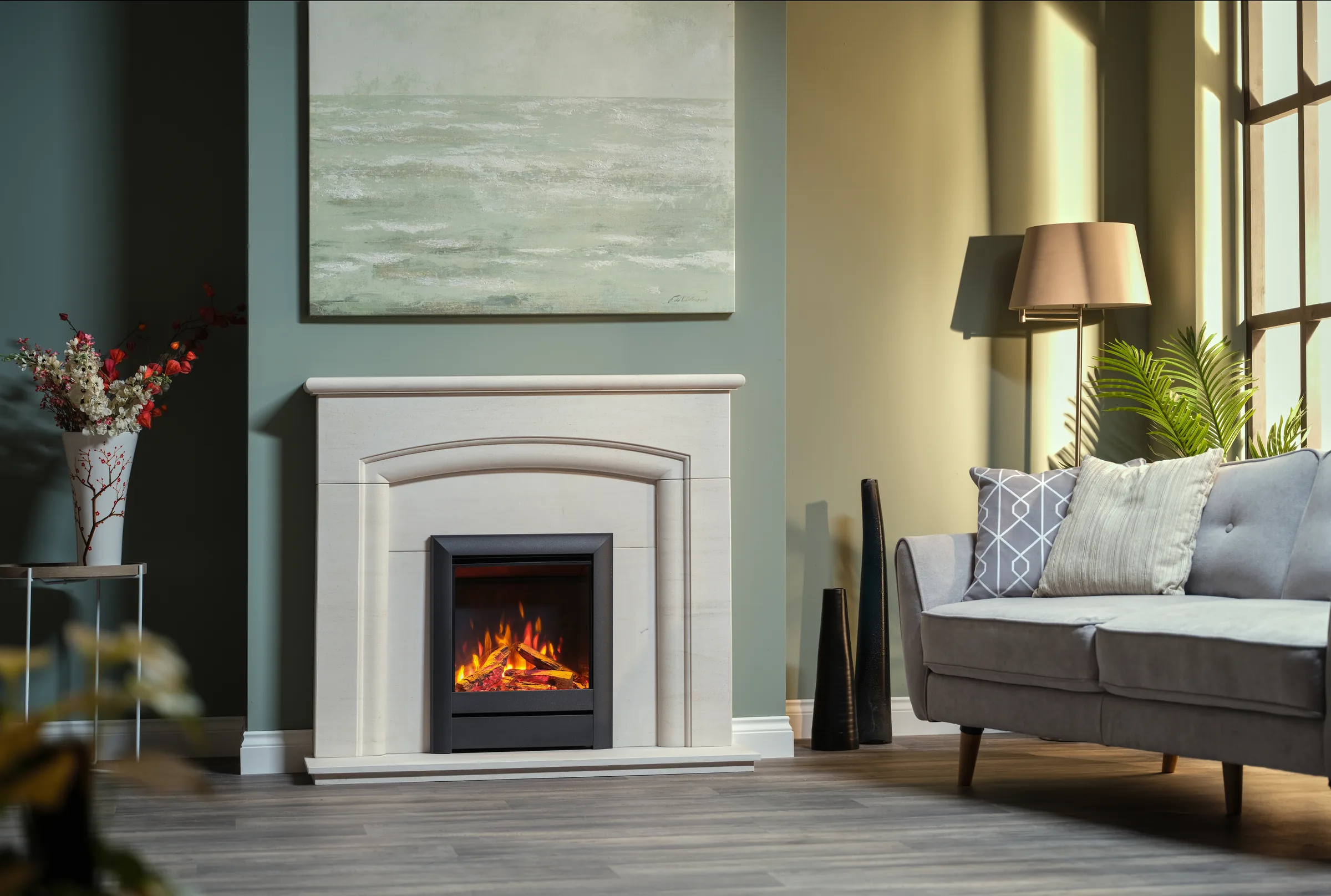
You can make a straightforward estimate once you know the appliance’s electrical input and how you plan to use it. The heater setting and flame-effect setting need to be considered separately.
Image: Wildfire Ravel 400E electric fire in a supplier room set. Illustrative supplier photograph; not BFC installation work.
The calculation
Use this formula:
Power in kilowatts × hours of use × electricity price per kilowatt-hour = estimated cost
A kilowatt is 1,000 watts. If the information on an appliance gives its electrical input in watts, divide by 1,000 to express that figure in kilowatts.
For an illustration, assume a heater draws 2 kW continuously for one hour and electricity costs 25p per kWh. The calculation is:
2 × 1 × £0.25 = £0.50
That is an example, not a statement of the current UK tariff or a quotation for a particular BFC fire. Replace 25p with the unit rate shown on your own tariff, including VAT where applicable.
Charlton & Jenrick explains the same power-and-time approach. Its published price examples should also be replaced with your own current rate.
Examples at an illustrative 25p per kWh
The table assumes continuous heater operation at the stated electrical input.
| Heater input | One hour | Three hours |
|---|---|---|
| 1 kW | £0.25 | £0.75 |
| 2 kW | £0.50 | £1.50 |
These figures cover the assumed heater input. Any additional electrical consumption by lighting, controls or other components must be included if it is not already part of the input figure you are using.
The electricity standing charge is separate. It normally remains payable whether you use the fire or not, so it is not an extra charge for each hour of fire use.
For a monthly illustration, a 2 kW heater running continuously for two hours a day over 30 days would use 120 kWh. At the same example rate of 25p per kWh, that would be £30. Different hours, tariffs and heater operation will change the result.
A thermostat changes the time the heater is actually on
Leaving a fire switched on for an evening does not necessarily mean its heater draws full power continuously. On a thermostatically controlled appliance, the heater may cycle as it works towards and maintains the selected temperature.
The room matters: its size, insulation, draughts, starting temperature and other heating all affect how much heat is needed. Opening doors into adjoining spaces can change that demand too.
Use continuous full-power operation as a clear assumption, rather than a prediction of every evening’s consumption. Do not apply an arbitrary percentage discount for a thermostat without measured evidence.
Flame-only use is a different calculation
Many electric fires let you use the flame effect without the heater. That can provide the appearance of a fire when the room is already warm.
It is still an electrical function, and its consumption depends on the model and settings. A small standby figure in a manual is not automatically the same as the power used by the full flame effect.
Check the specification for the exact mode you intend to use. If a reliable input figure is available, apply the same calculation. Avoid assuming that all electric fires cost the same to run with the heat off.
Compare the way you will actually use it
Before choosing a fire, think about three things:
- How often you want additional heat.
- How many hours you expect to use the flame effect.
- Whether you mainly heat one room or several connected spaces.
A decorative focal point used without heat for much of the year is a different use pattern from a fire providing regular supplementary warmth. The purchase and installation costs should also be considered alongside energy use.
Electricity and gas prices alone do not establish which complete heating arrangement will be cheaper for your home. Appliance efficiency, useful heat, usage and installation costs all affect that comparison.
Choose with the room in mind
A suitable fire should give you the appearance and controls you want, with an output appropriate to its intended role. Ask about heat settings, temperature control and the manufacturer’s stated electrical input.
Berkshire Fireplace Centre offers free home consultations within 20 miles of Reading. We can discuss your room and usage, explain the installation considerations, and help you compare the relevant appliance information.
Keep reading
More from the team
No showroom. We come to you.
Book a free in-home consultation
We visit your home with brochures and samples, look at the room and the chimney, and help you choose. No charge, no obligation, and no showroom to drive to.